

Collecting Unpaid Invoices: A Small Business Guide
Collecting unpaid invoices starts with a structured follow-up system: send invoices immediately, track every due date, and follow up on a set schedule after the due date. Businesses with cash flow problems may struggle paying vendors or employees. Senior-level bookkeepers reconcile receivables monthly, flagging overdue accounts before they disrupt operations.
What do you need before collecting unpaid invoices?
Collecting unpaid invoices starts with organized records. Accounts receivable is the money customers owe a business for work completed or goods delivered. Without clean data, collection efforts waste time and strain client relationships.
What records should a business review before contacting a customer?
Three documents form the foundation of any collection call. The original invoice must show the correct amount, date, and payment terms. Payment history reveals whether the customer has a pattern of late payments or a single missed obligation. Any correspondence about the invoice, such as disputed charges or promised payment dates, provides essential context.
A business owner who skips this review risks demanding payment for an invoice the customer already settled. The embarrassment damages trust. Worse, the owner loses leverage on genuinely past-due accounts while chasing resolved ones.
How does an AR aging report help prioritize collection work?
An AR aging report sorts unpaid invoices by how long they have been overdue. Common buckets include 0 to 30 days, 31 to 60 days, 61 to 90 days, and over 90 days. This report shows exactly which balances demand immediate attention and which can wait another week.
Prioritization matters because collection energy is finite. A 90-day balance carries far higher non-payment risk than a 15-day balance. The report also flags customers whose aging balances grow month over month, a pattern that signals deeper payment problems. Rev Your Bookkeeping’s own team handles accounts receivable management as part of its bookkeeping work, giving business owners this visibility without building it themselves.
A consistent process helps businesses get paid sooner and makes cash flow easier to manage.
How do you set up an AR aging report?
An ar aging report organizes unpaid invoices into time-based buckets. The report groups receivables by how long each invoice has been outstanding, typically in 30-day increments. Without this structure, overdue balances blend with current ones and cash flow problems stay hidden until a payment fails.
What data does an AR aging report require?
The report pulls from three core records. First, every open invoice with its issue date and due date. Second, the outstanding balance on each invoice. Third, the customer name and payment terms. Accounts receivable software automates the process of tracking and collecting unpaid invoices by pulling this data directly from the ledger. Manual spreadsheets work for a handful of invoices. They break down fast as transaction volume grows.
How do you build the aging buckets?
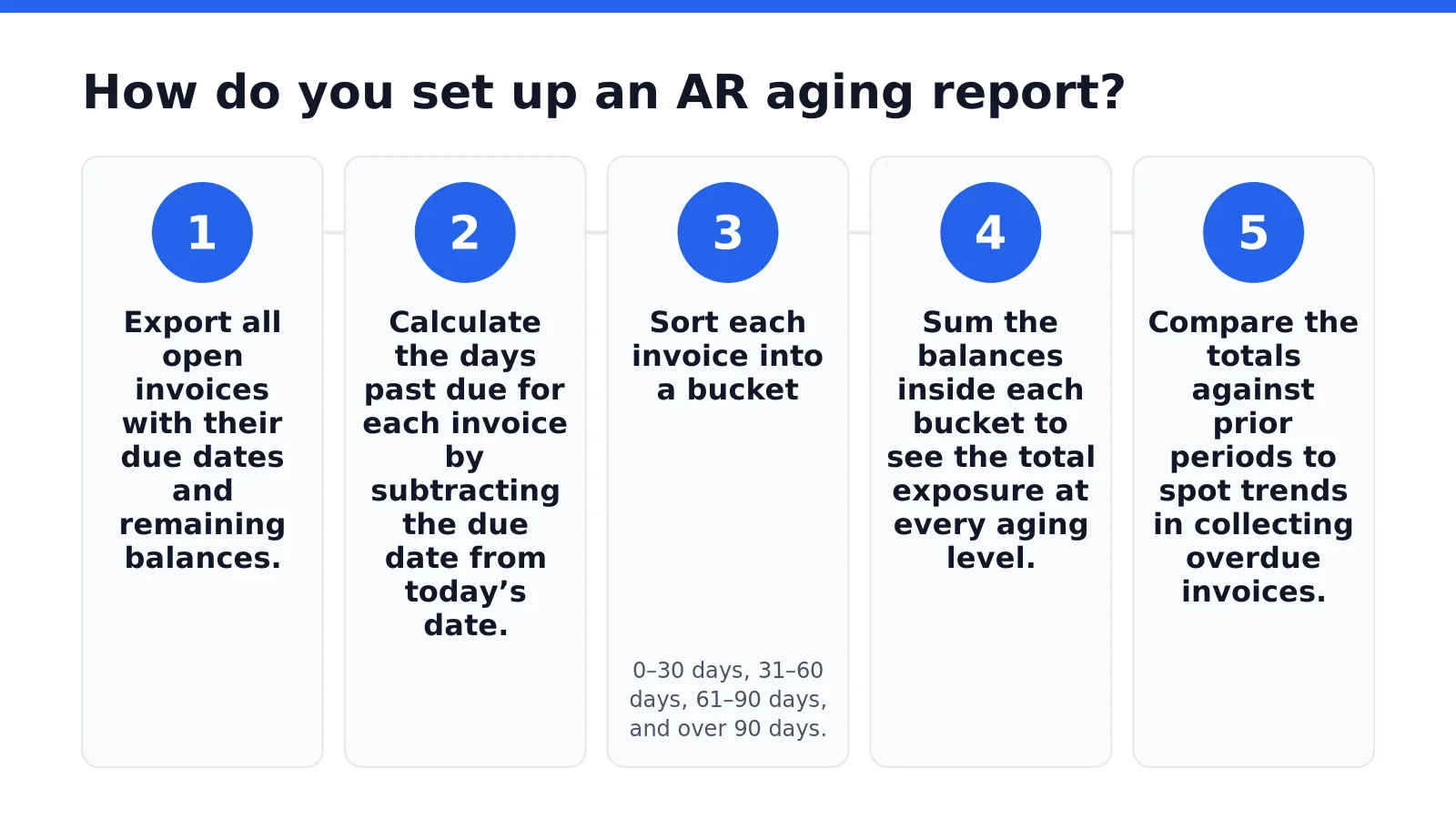
- Export all open invoices with their due dates and remaining balances.
- Calculate the days past due for each invoice by subtracting the due date from today’s date.
- Sort each invoice into a bucket: 0 to 30 days, 31 to 60 days, 61 to 90 days, and over 90 days.
- Sum the balances inside each bucket to see the total exposure at every aging level.
- Compare the totals against prior periods to spot trends in collecting overdue invoices.
The 61 to 90 day and 90-plus day columns deserve immediate attention. Balances that age past 60 days become harder to collect with every passing week. A business owner who reviews only the total receivables number misses this deterioration entirely.
What makes the report actionable?
An ar aging report is not a static document. Rev Your Bookkeeping’s team flags cash flow concerns and unusual variances before the client asks. Accuracy is non-negotiable: every number is reconciled before a close goes out. That standard turns the aging report into a reliable tool for how to collect past due invoices. A reconciled report shows exactly which customers need a follow-up call today. It also reveals whether collecting past due invoices requires a revised payment plan or a firmer collections process. The report guides how to follow up on unpaid invoices with precision rather than guesswork.
How to follow up on unpaid invoices step by step?
Following up on unpaid invoices requires a structured, consistent process that moves from sending invoices and monitoring unpaid balances to following up and recording payments. A haphazard approach leaves cash tied up in receivables. Even businesses with steady sales face operational risk when customer payments stall, which makes strong accounts receivable management essential.
What should a business do before the first follow-up?
Before any outreach, confirm the invoice was delivered to the correct contact and that all details are accurate. A missing purchase order number or wrong billing address causes most silent delays. Verify the payment terms printed on the invoice match the agreement. This five-minute check prevents awkward conversations about errors the business itself made.
When is the right time to send the first reminder?
Send the first reminder one day after the due date. Waiting a week signals that late payment carries no urgency. The message stays brief and professional: reference the invoice number, amount, and due date, then ask if payment has been scheduled. Attach the original invoice again so the customer does not need to search for it.
How to follow up on unpaid invoices effectively comes down to a clear sequence of actions:
- Day 1 after due date: Email a friendly reminder with the invoice attached.
- Day 7: Place a phone call to the primary contact. Ask directly whether there is a problem with the invoice or the work.
- Day 14: Send a second email that references the prior call and states the overdue balance plainly.
- Day 21: Escalate to a manager or owner-level contact if the account has a history of slow payment.
- Day 30: Mail a printed statement marked “Past Due” and pause future work or shipments until the balance clears.
Each step adds pressure without burning the relationship. The goal is payment, not confrontation.
What does an AR aging report reveal about overdue invoices?
An ar aging report groups unpaid invoices by how long they have been outstanding, typically in 30-day buckets. A business owner reviewing this report spots which customers are drifting past 60 or 90 days. That visibility drives which accounts need a phone call versus a final demand letter. Without the report, collecting overdue invoices becomes guesswork, and the oldest balances quietly become uncollectible.
Rev Your Bookkeeping’s senior-level team handles accounts receivable management for growing businesses. Collecting past due invoices stops being a personal stress point when the process runs on a disciplined schedule. Collecting unpaid invoices consistently protects the cash flow that payroll, vendor payments, and growth depend on.
How to collect past due invoices without damaging relationships?
Collecting past due invoices requires a structured, respectful process. Strong accounts receivable management builds better client relationships and reduces financial risk. A business owner who treats overdue balances as a routine workflow issue, not a personal conflict, preserves trust while recovering cash.
The stakes are real. Cash flow problems make it hard to pay vendors, make loan payments, or pay employees. Every week an invoice sits unpaid, the business absorbs that gap. A clear follow-up sequence prevents small delays from becoming serious collection problems.
Confirm the invoice details are correct before contacting the client. Verify the amount, due date, and delivery method. A wrong email address or missing purchase order number delays payment through no fault of the client.
Keeping a respectful tone during follow-up communications is essential to maintain good client relationships. For larger balances, offering a payment plan helps ease financial strain for clients while ensuring the business recovers funds effectively.
How does an AR aging report support this process?
An ar aging report groups unpaid invoices by how long they are overdue. The report shows which clients need a first reminder and which need firmer action. Business owners who review this report weekly catch overdue balances before they age further.
Rev Your Bookkeeping treats messy or behind books as problems to solve, not character flaws. The team tracks collecting overdue invoices and collecting past due invoices as part of monthly bookkeeping. Our client agreements commit us to delivering monthly financial reports by the 15th of every month. That schedule gives owners a current view of receivables before follow-up decisions are made.
What common mistakes hurt collecting overdue invoices?
Disorganized accounts create serious obstacles for business owners. The accounting department often finds managing accounts receivable to be one of the most difficult operational tasks. Several common mistakes consistently undermine efforts at collecting overdue invoices and recovering cash that a business has already earned.
The main mistakes include sending invoices late or to the wrong contact, maintaining unreconciled records, and inconsistent follow-up with customers. These issues lead to payment delays and growing receivables that strain the business’s cash flow.
Rev Your Bookkeeping serves owners from startup stage up to about $25 million in revenue across multiple industries.
Related reading: see how outsourced accounts payable reconciliation works on the other side of the ledger, and what is covered in reading a profit and loss statement once your receivables are current.
Ready to Get Your Books in Order?
Take control of your accounts receivable and improve your cash flow today. Schedule your free discovery call with the Rev Your Bookkeeping team to review your books and discuss tailored solutions.


