
Profitable but No Cash: Why It Happens and How to Fix It
If your business is profitable but no cash shows up in the bank, you are not imagining things. A profitable business runs short of cash when revenue sits in unpaid invoices while bills come due, because accrual accounting books revenue when it is earned, not when the money arrives. Reconciled books show exactly where the cash went.
Why is my business profitable but I have no cash?
A business shows a profit while the bank account runs dry because profit vs cash are fundamentally different measurements. Profit is not cash. Profit is a paper calculation of revenue minus expenses, recognized when earned under accrual accounting rules. Cash flow is the actual dollars available in a bank account to pay bills right now.
A construction company that completes a roofing job illustrates the gap perfectly. The income statement records revenue immediately. The cash does not arrive for weeks. Meanwhile, payroll, material suppliers, and insurance premiums demand payment this week. The books show a healthy margin. The checking account tells a different story.
What causes the gap between profit and cash?
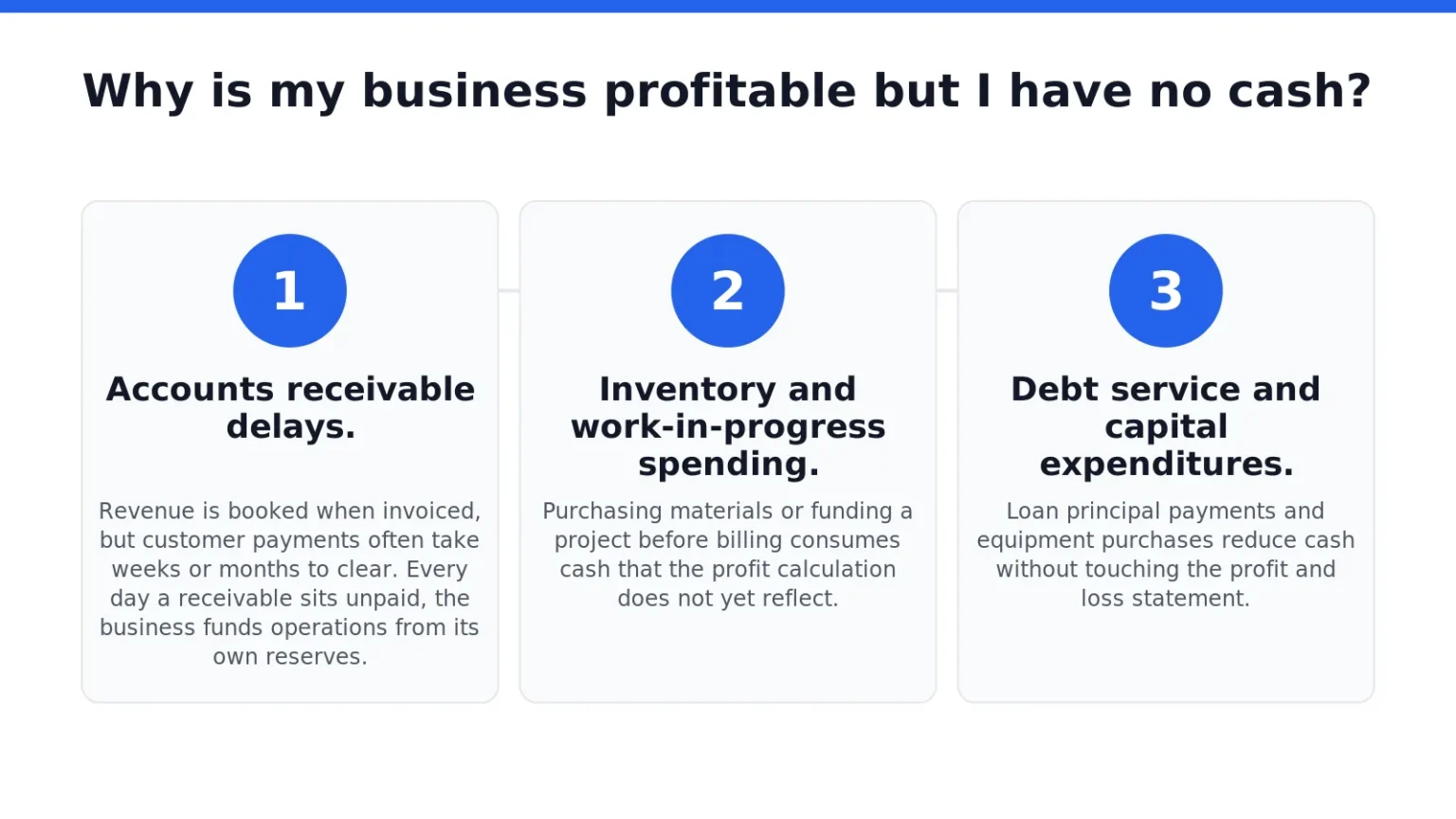
Three operational realities create the disconnect between paper profitability and real cash:
- Accounts receivable delays. Revenue is booked when invoiced, but customer payments often take weeks or months to clear. Every day a receivable sits unpaid, the business funds operations from its own reserves.
- Inventory and work-in-progress spending. Purchasing materials or funding a project before billing consumes cash that the profit calculation does not yet reflect.
- Debt service and capital expenditures. Loan principal payments and equipment purchases reduce cash without touching the profit and loss statement.
How can a business be profitable on paper and still run out of money?
A business can be consistently profitable but no cash appears in the bank because accrual accounting separates earnings from collections. Revenue recognition happens at the point of sale or service completion. Cash collection happens later, sometimes much later. A company that grows quickly often amplifies this problem. More sales mean more receivables, more inventory, and more upfront costs, all before a single dollar of new revenue arrives.
Without reconciled books that track both the income statement and the cash position, an owner sees only half the picture. A bookkeeping review that examines reconciliations, categorization, and reporting accuracy reveals whether the numbers on the screen match the money in the account. Rev Your Bookkeeping’s mission is to give growing businesses access to the financial clarity that large companies have always had. When the books close each month with every account reconciled, the owner stops guessing why profitable but no cash flow keeps happening and starts managing the real drivers of cash.
Why Profit and Cash Are Not the Same Thing
Profit is an accounting concept while cash is a banking reality, and a business records revenue when an invoice goes out, not when payment arrives.
Several specific activities create the disconnect. Each one drains the bank account without touching net income.
Why does a profitable business run out of money?
A contractor finishes a job and invoices the customer, booking the revenue right away. Payment arrives weeks later while materials, labor, and fuel were already paid. The profit appears on paper. The cash is gone.
What balance sheet activities affect cash but not profit?
Several transactions move cash without appearing on the income statement:
- Debt principal payments reduce the bank balance but never show as expenses
- Owner draws and distributions take cash out while leaving net income untouched
- Inventory purchases tie up funds in stock that has not yet sold
- Capital raises bring cash in without creating profit
These activities explain why profit is not cash. A business owner staring at a healthy P&L can still face an empty checking account.
How do timing differences create the problem?
Expenses often hit before revenue arrives. Payroll runs every two weeks. Suppliers demand payment on delivery. Customers pay on their own schedule. The mismatch between outgoing cash and incoming payments creates the crunch that no income statement reveals.
Owners experiencing profitable but no cash flow need books that track both measures separately. Reconciled records show exactly where cash sits at any moment, not just what profit the accrual method reports.
How do I calculate my real cash position?
Calculating a real cash position requires looking beyond the profit and loss statement. A business owner must examine the balance sheet and cash flow statement together. Profit is not cash, and the income statement alone hides the timing gaps that drain bank accounts.
The process starts with reconciled books. Every bank and credit card account must be reconciled each month, and a clear process for closing the books each month makes the cash balance something you can trust.
What three documents show my true cash position?
Three financial statements reveal the full picture. The balance sheet lists actual cash on hand as of a specific date. The cash flow statement tracks where money entered and exited the business during the period. The profit and loss statement shows revenue earned and expenses incurred, regardless of when cash changed hands. Reviewing all three together exposes the difference between profit vs cash.
How do I reconcile my accounts to find real cash?
Follow these steps each month to calculate an accurate cash position:
- Reconcile every bank and credit card account. Match each transaction in the accounting system to the corresponding bank or card statement line. Any unmatched item signals a cash balance that does not reflect reality.
- Review uncategorized transactions. Transactions sitting in a suspense or “ask my accountant” account distort both the balance sheet and the cash flow statement. Assign each one to the correct category.
- Check the profit and loss against the balance sheet. A profitable month that shows a falling cash balance points to receivables, inventory purchases, or debt payments absorbing the cash. The balance sheet tells that story.
- Verify the ending cash balance. The reconciled bank balance, minus any outstanding checks or deposits in transit, must match the cash account on the balance sheet. A mismatch means the close is incomplete.
Accuracy is non-negotiable. Every number is reconciled before a close goes out. Rev Your Bookkeeping delivers each client’s monthly financial reports by the 15th of every month, and the firm is contractually obligated to meet that deadline. The team flags cash flow concerns, unusual variances, and margin trends before the client asks, so a business owner never faces a profitable but no cash surprise without warning.
What steps fix a profitable but cash-poor business?
Fixing a business that is profitable but has no cash requires immediate steps to align accounting records with actual bank balances. Profit vs cash confusion disappears once the books reflect reality. A good first step is a free discovery call with the Rev Your Bookkeeping team to review the current books. This initial review reveals whether the core problem stems from reporting gaps or operational cash drains.
How does catch-up bookkeeping reveal the real cash problem?
Catch-up bookkeeping brings behind or messy books current. The process uncovers the true cash position by reconciling every account and categorizing every transaction. Business owners switching from an existing bookkeeper receive a review of prior work and gap fixes before ongoing services begin. Without this step, cash decisions rest on incomplete data.
What ongoing practices prevent the cash crunch from returning?
Three disciplines keep a business solvent once the books are clean. First, accounts receivable management ensures the company tracks and collects what it is owed on time. Second, monthly financial reporting provides the three-statement visibility needed to protect liquidity. Third, a systematic bookkeeping cleanup process catches errors before they distort cash projections.
Why am I profitable but have no cash flow despite strong sales? The answer lives in the balance between receivables, payables, and inventory. Profit is not cash, and a P&L statement never tells the full story. A business that invoices customers on 60-day terms while paying suppliers in 30 days can show healthy margins and still empty its bank account. Real control comes from reconciled books and disciplined cash management, not from the income statement alone.
When should I outsource bookkeeping for cash clarity?
A business owner should outsource bookkeeping when the profit-and-loss statement shows a gain but the bank balance tells a different story. That disconnect signals that internal financial tracking has fallen behind real-time cash movement.
Profit is not cash, and the gap between the two widens when receivables, payables, and timing differences go untracked. A company can post a strong month on paper while invoices sit unpaid for 30 to 60 days. Without reconciled books, the owner sees profit without seeing the cash drain underneath it.
What triggers the move from DIY books to an outside team?
Three conditions make outsourcing the right next step. First, the owner spends more time on QuickBooks than on revenue-generating work. Second, month-end arrives and the books are not closed, leaving decisions to be made on guesswork. Third, the business has reached a revenue level where transaction volume overwhelms a part-time approach.
Rev Your Bookkeeping handles all bookkeeping responsibilities directly for its clients. The firm serves founders of growing businesses anywhere in the United States, from startup stage up to about $25 million in revenue. Its team delivers senior-level expertise at a fraction of the cost of hiring a full-time controller or CFO in house.
How does outsourced bookkeeping prevent cash surprises?
Proactive communication makes the difference. The team flags cash flow concerns before the client asks, catching unusual variances and margin trends early. That focus shapes a service built to stop the profitable but no cash problem before it escalates.
Clean, timely books turn the profit vs cash confusion into a clear picture. Owners who outsource gain financial clarity without the overhead of an internal hire. The benefits of outsourced bookkeeping extend beyond saved time to the confidence that every number has been verified before a report lands on the owner’s desk.
Ready to Get Your Books in Order?
If your business looks profitable but the bank account says otherwise, our team can help you see where the cash went. Schedule your free discovery call and let’s take a look at your books together.


